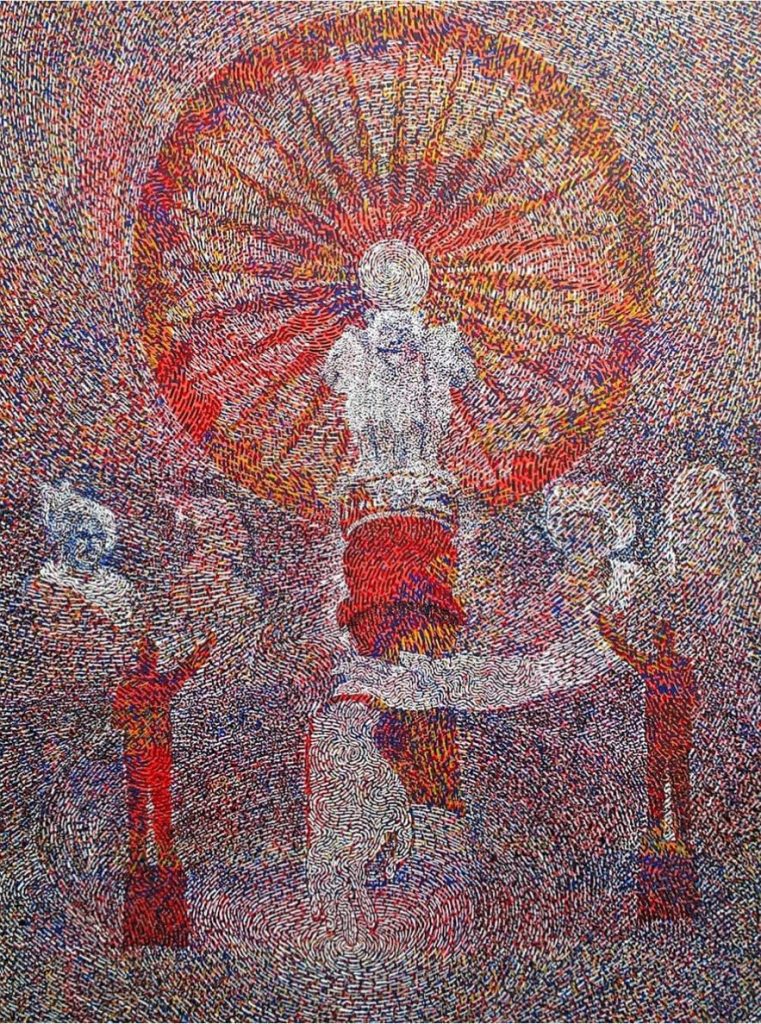
“Shaktangan” unfolds as a powerful visual invocation of collective strength and spiritual vitality. At the centre, a radiant circular form dominates the composition, resembling both a cosmic halo and a pulsating energy field. From this vibrating core emerges a white, almost ethereal figure elevated on human shoulders, suggesting ritual elevation, reverence, and communal empowerment. The title’s evocation of “space of power” finds visual expression in this moment: the human body becomes both vessel and conductor of an immense, luminous force.
The artist constructs this sense of energy through meticulous mark-making. Countless short, directional strokes cluster, swirl, and radiate, creating a dense tapestry of movement. Rather than functioning as mere texture, these marks behave like currents of sound or breath—alive, rhythmic, and unceasing. The chromatic interplay of reds, yellows, blues, and whites heightens the sensation of vibration, as if the air itself trembles with emotional and spiritual intensity.
The figures supporting the central form introduce an essential grounding presence. Their bodies, rendered in strong reds and structured outlines, appear both physically burdened and spiritually elevated. They are not anonymous labourers; they are participants in an act of devotion, guardians of a shared ritual. Around them, faint apparitions and secondary figures emerge from the patterned field, hinting at memory, ancestral presence, or unseen forces participating in the event. This layering expands the narrative beyond a single moment into a continuum of cultural and emotional inheritance.
What distinguishes this work is its refusal to separate the metaphysical from the physical. The divine is not distant or monumental; it arises from human bodies, collective effort, and lived community. The painting’s pointillistic density requires slow looking, revealing structure within intensity and intention within apparent chaos. As the eye travels across the surface, the viewer experiences the sensation of entering a charged environment rather than merely observing it.
“Shaktangan” ultimately becomes less a depiction of ritual than an embodiment of it. Through controlled complexity, it celebrates resilience, shared faith, and the transformative potential of unity—reminding us that power, in its truest form, is something generated, carried, and protected together.