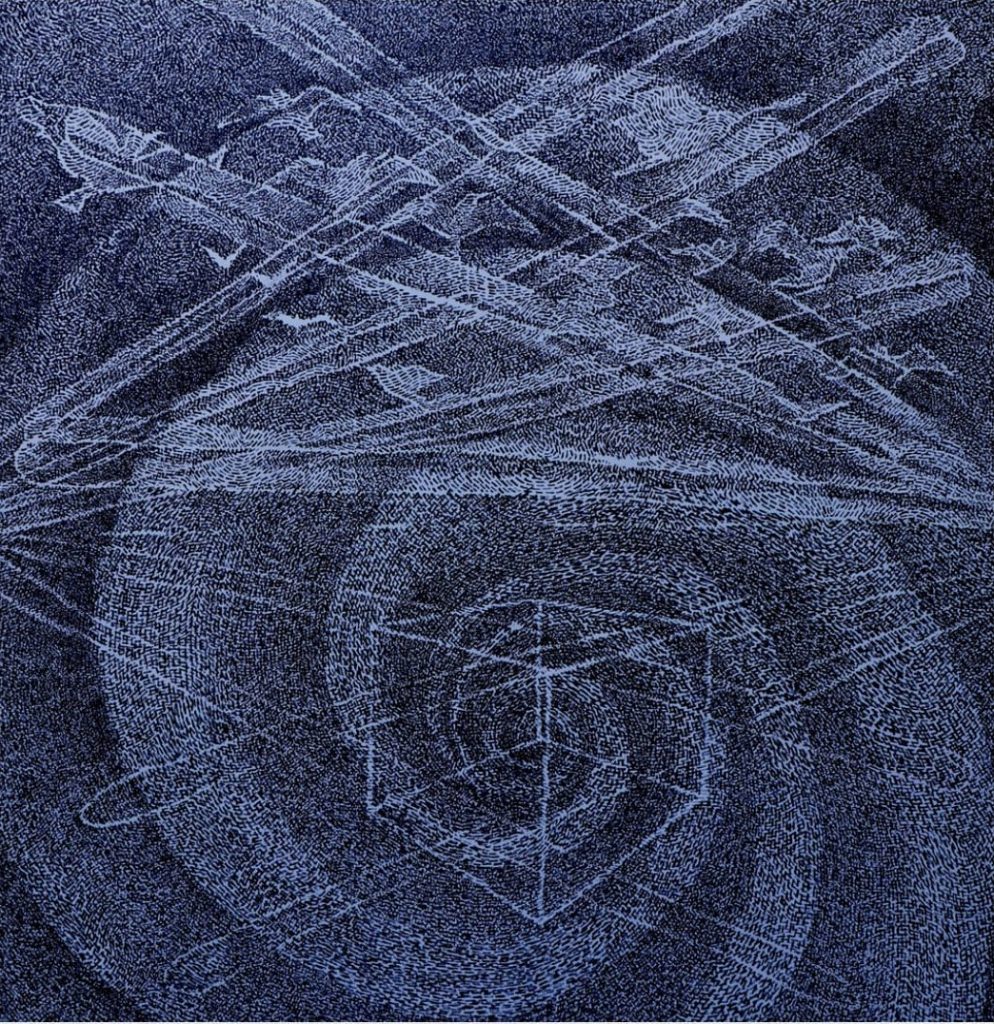
“Lockdown” distills an era of collective paralysis and psychological turbulence into a meticulously constructed visual field of restrained colour and restless motion. Dominated by deep tonal variations of blue, the work resists drama in palette yet sustains intense emotional pressure through structure. At first glance, a vast spiral draws the viewer inward, evoking the sensation of being pulled into a silent vortex—time collapsing, movement suspended, life circling back onto itself. The spiral does not simply decorate the surface; it becomes a psychological space, echoing isolation, containment, and the cyclical rhythms of repeated days.
Across this dense rotational field, geometric forms and architectural lines intersect, slice through, and hover. Their precision contrasts with the organic swirl beneath, suggesting systems of control, invisible barriers, enforced order. Within these linear grids one senses borders, cityscapes, maps without access—spaces that exist yet cannot be entered. The faint cube-like structure near the centre implies containment: a life boxed, thought confined, existence measured by boundaries rather than horizons. It is not a prison illustrated literally; it is a condition felt.
The extraordinary textural density of tiny marks—each deliberate, each almost obsessively placed—mirrors the monotony of repetitive routines, the compulsive counting of days, the heightened awareness of smallness during enforced stillness. This granular surface holds tension between patience and agitation. The composition is quiet but never calm; it vibrates internally, like a held breath.
Above the spiral, faint silhouettes in motion appear almost ghostlike, evoking memories of movement—airplanes, migration, journeys—suspended in time. They read as traces of what once was normal, now reduced to echoes. Their pale presence against the nocturnal field underscores the fragility of mobility and the stark shift between open skies and grounded existence.
“Lockdown” succeeds because it neither dramatizes nor sentimentalizes the subject. Instead, it constructs a visual psychology—measured, immersive, and deeply introspective. It captures not the spectacle of crisis, but its interior architecture: containment, lingering uncertainty, and the uneasy quiet where stillness and anxiety coexist.