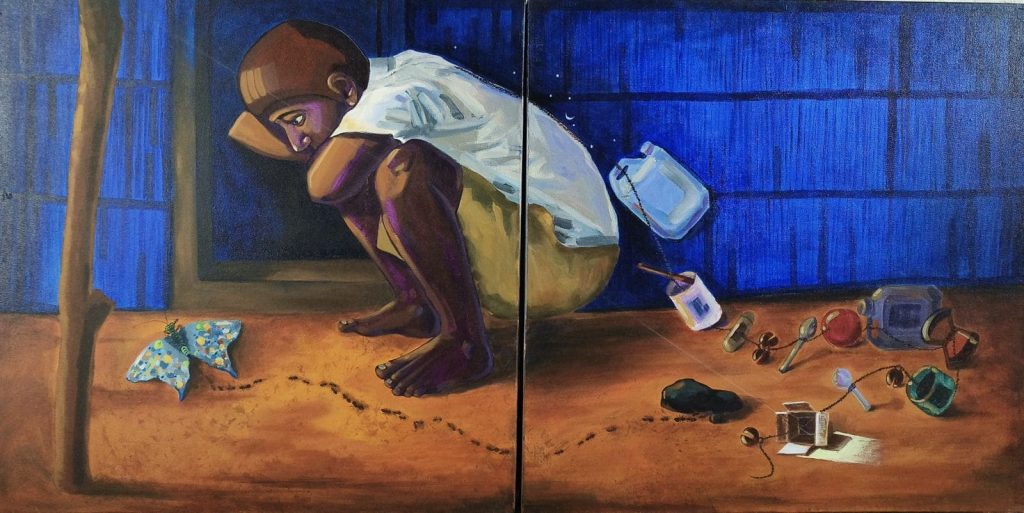
In this evocative diptych, Jagruti Sonawane turns an intimate moment of childhood observation into a profound meditation on attention, vulnerability, and the quiet weight of existence. A young boy crouches close to the earth, his body folded into a posture of watchfulness, eyes fixed on a delicate procession of ants that crosses the threshold of his small world. Around him, everyday objects—discarded toys, makeshift inventions, fragments of domestic life—scatter like unspoken memories. They suggest both play and precarity, evoking a life shaped not by abundance but by resilience and imagination. Against the saturated depth of the blue backdrop, the boy becomes a still centre of consciousness, poised between innocence and the dawning complexities of awareness.
Sonawane uses light, colour, and spatial tension to heighten psychological presence. The warm tones of the ground pull the viewer into the tactile immediacy of the scene, while the luminous insect resting nearby introduces an almost dreamlike shimmer, hinting at wonder amid ordinariness. The diptych format subtly reinforces duality: interior and exterior worlds, vulnerability and curiosity, fragility and endurance. Though the child appears physically small, his concentration suggests a profoundly mindful engagement—echoing the artist’s broader interest in Buddhist philosophy and the possibility that attentiveness can transform even the simplest moment into an act of presence.
This work does not sentimentalise childhood; instead, it reveals its gravity, its capacity to contain solitude, imagination, and quiet strength. Sonawane invites the viewer to kneel mentally beside the boy, to feel the hush of the scene, and to recognise in this seemingly modest act of watching ants a tender metaphor for the human condition: our instinct to observe, to cope, to find meaning in the minute textures of life, even when the world around us feels uncertain.