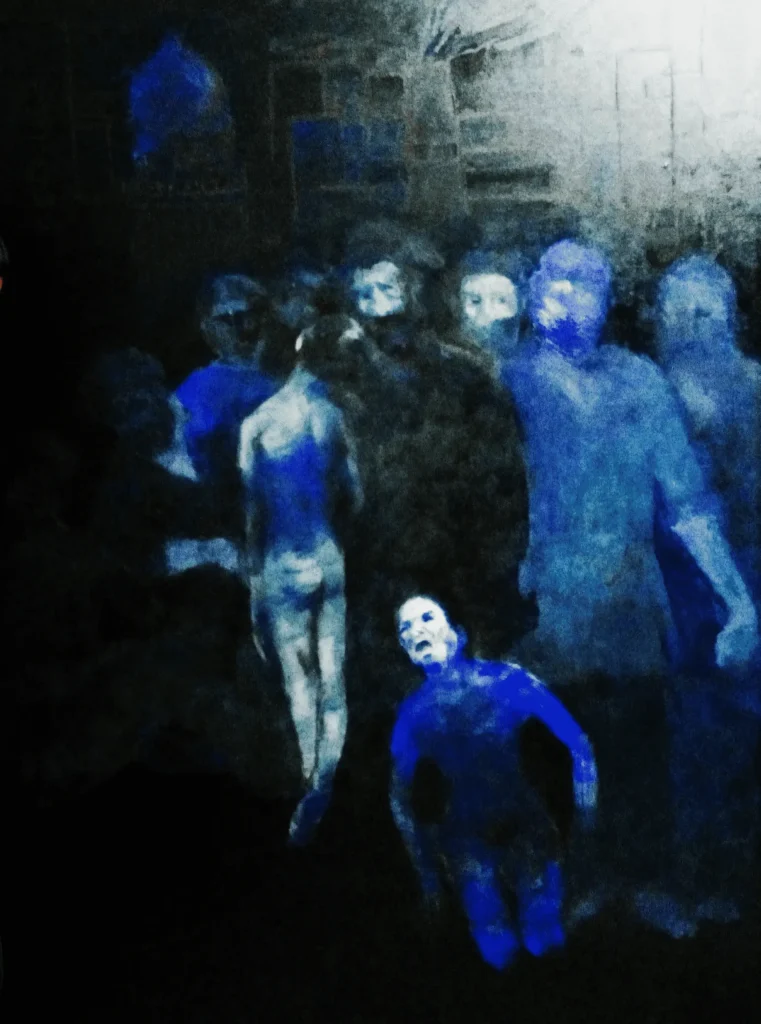
In this haunting and psychologically charged composition, Gopal Gangawane immerses the viewer in a spectral atmosphere where human presence flickers between visibility and dissolution. A gathering of ghostlike figures, rendered in deep blues and muted shadows, emerges from darkness as though rising from memory, trauma, or collective unconscious. Faces glow with uneasy illumination—some vacant, some fearful, some hauntingly aware—creating a chorus of silent witnesses suspended in an ambiguous space between existence and disappearance.
At the forefront, isolated figures intensify the work’s emotional gravity. One kneels in anguish, mouth open in a cry that remains soundless; another stands exposed and vulnerable, their back turned, absorbed into the surrounding void. These bodies are not simply forms; they are embodiments of psychological states—alienation, grief, fear, and the fragile longing for recognition. The anonymity of the crowd amplifies the sense of shared humanity while underscoring how easily individuality can dissolve under emotional or societal pressures.
Gangawane’s handling of color and light deepens the work’s resonance. The dominant blue palette evokes coldness, emotional distance, and nocturnal depth, while subtle transitions of tone allow figures to emerge and recede like fading memories or restless spirits. The indistinct spatial setting—neither fully real nor entirely imagined—creates a liminal world where time feels suspended and narrative hovers on the edge of comprehension.
Rather than depicting overt violence or spectacle, the painting reveals psychological aftermath—the echo of unseen events, the weight of suppressed emotion, and the invisible pressures shaping human existence. It is a work of profound empathy and existential reflection, inviting viewers to confront vulnerability, shared fragility, and the haunting interior landscapes we often carry silently within us.